Blockchain Timestamping adn Its Application to Verifying Session Integrity in Regulated Virtual Gambling Platforms
Écrit par Zoe Foster · 3/10/2026

Blockchain Timestamping adn Its Application to Verifying Session Integrity in Regulated Virtual Gambling Platforms
Blockchain timestamping creates permanent records of digital events by anchoring data hashes to distributed ledgers at precise moments, and this mechanism has found direct application in regulated virtual gambling platforms where session integrity must remain verifiable against tampering attempts. Operators record game states, player actions, and outcome sequences through cryptographic hashes that receive immutable timestamps, allowing regulators and auditors to confirm that no alterations occurred after the fact.
How Blockchain Timestamping Works in Digital Environments
Systems generate a hash of session data at regular intervals, then submit that hash to a blockchain network where nodes confirm the timestamp through consensus mechanisms, and this process produces a chain of verifiable entries that link each moment to the next without requiring centralized storage. Researchers at institutions such as the University of Cambridge have documented how these anchored records resist retroactive changes because any modification would break the hash chain and become immediately detectable during verification.
Regulated platforms integrate this approach by embedding timestamping protocols directly into their gaming servers, so every spin, bet, and payout receives a cryptographic seal that external parties can audit independently. Data from the European Commission indicates that several member states have begun requiring such tamper-evident logging for online gambling operators as part of broader digital compliance frameworks.
Application to Session Integrity Verification
Session integrity verification relies on the ability to reconstruct events in exact chronological order while proving that recorded outcomes match the original execution, and blockchain timestamps supply this proof by creating independent checkpoints that cannot be forged without detection. When disputes arise over whether a session proceeded fairly, auditors retrieve the timestamped hashes and compare them against the live data to determine whether any divergence exists.
Platforms operating under French regulatory oversight, among others, use these records to demonstrate compliance during routine inspections, and similar requirements appear in guidelines issued by the Malta Gaming Authority and the Nevada Gaming Control Board. Each jurisdiction recognizes that timestamped blockchain entries provide stronger evidentiary value than traditional server logs because the distributed nature of the ledger eliminates single points of failure or manipulation.
Regulatory Context and Implementation Trends
By October 2026, several European jurisdictions plan to finalize technical standards that explicitly reference blockchain-based timestamping for virtual session logging, according to policy documents released by national gambling authorities. These standards aim to align record-keeping practices across borders so operators can demonstrate consistent integrity measures regardless of where their servers are located.
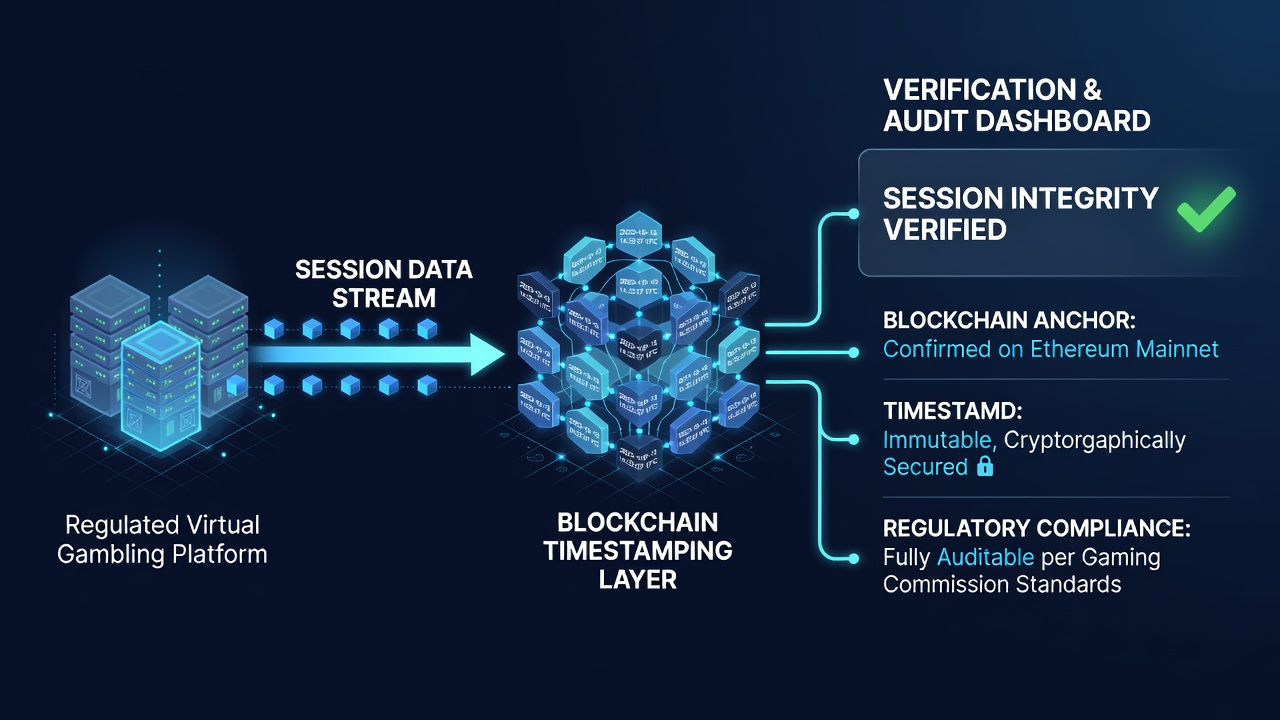
Implementation typically involves three layers: the gaming engine generates raw session data, an intermediary service creates and submits hashes at fixed intervals, and the blockchain network returns confirmation receipts that operators store alongside their internal records. This architecture allows platforms to maintain performance while still satisfying audit requirements from bodies such as the Australian Communications and Media Authority and the Alcohol and Gaming Commission of Ontario.
Technical Considerations for Gambling Operators
Operators must select blockchain networks with sufficient throughput and finality guarantees to handle high-frequency session events without introducing latency that could affect gameplay, and studies from the Blockchain Research Institute show that permissioned or hybrid chains often provide better suitability for regulated environments than fully public networks. Latency under 500 milliseconds remains a common operational target for timestamp submissions during active sessions.
Integration also requires careful key management because the cryptographic signatures attached to each timestamp must remain secure throughout the retention period mandated by local regulations. Those who manage these systems report that multi-signature schemes adn hardware security modules reduce the risk of key compromise while preserving the ability to prove authenticity during external reviews.
Challenges and Ongoing Developments
Scalability continues to present practical hurdles because the volume of timestamp requests can reach thousands per second during peak periods on major platforms, and network congestion may delay confirmations if operators rely on public chains without optimized batching methods. Industry reports from the European Gaming and Betting Association note that many operators now batch multiple session hashes into single transactions to reduce costs and improve efficiency.
Interoperability between different blockchain timestamping services and existing regulatory reporting tools represents another area of active development, with working groups exploring standardized data formats that would allow seamless transfer of verification records to government databases. Progress on these standards is expected to accelerate through 2026 as more jurisdictions codify blockchain requirements into licensing conditions.
Conclusion
Blockchain timestamping supplies regulated virtual gambling platforms with a verifiable method for preserving session integrity through immutable chronological records that resist post-event alteration. Implementation continues to evolve alongside regulatory expectations, and multiple jurisdictions have signaled that timestamped ledger entries will form part of standard compliance evidence in coming years. The combination of cryptographic hashing, distributed consensus, and precise timing creates an audit trail that supports both operational transparency and regulatory oversight without compromising platform performance.